
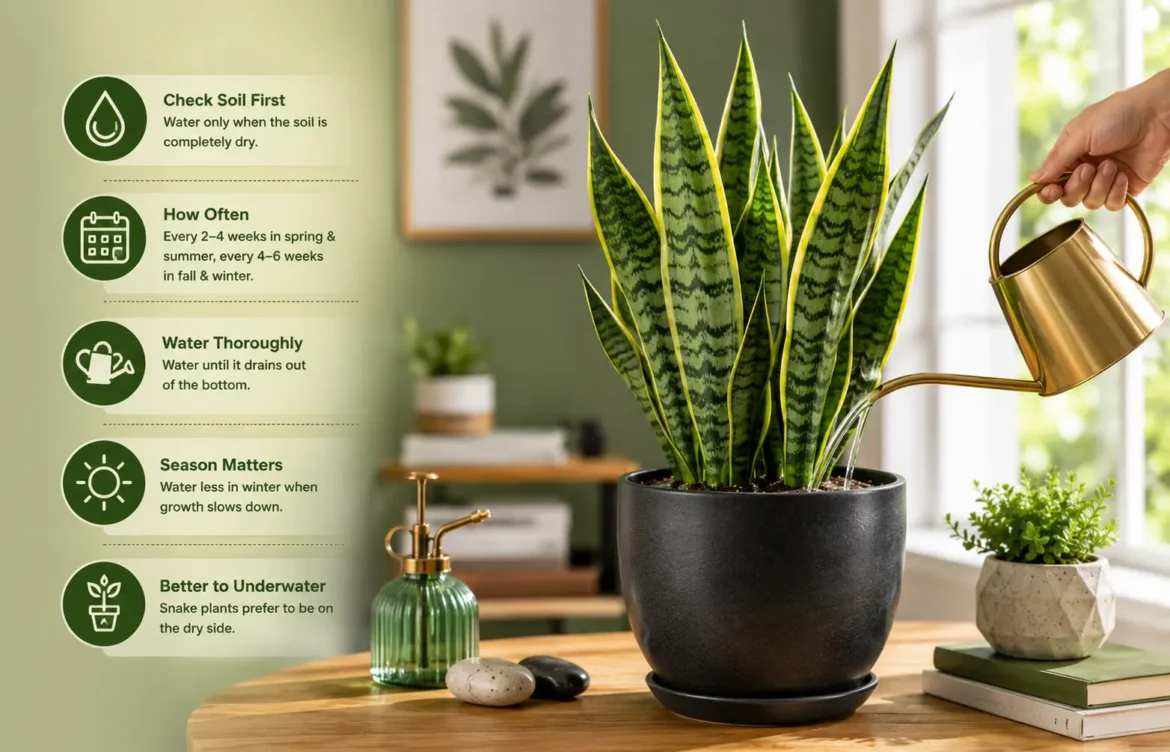
Snake Plant Watering Guide: How Much and How Often
More Snake Plants are lost to watering too often than to any other cause. This plant stores water in its thick leaves, so it can go for weeks without a drink, and it actually prefers that over consistently moist soil. This guide covers exactly how much to give it, how to tell when it is time, how that changes with the seasons, and the small habits that make the biggest difference.
Why Snake Plants Need So Little Water
Snake Plants are succulent-like plants, which means their thick, upright leaves act as water storage tanks. In the wild, they grow in dry, rocky parts of West Africa, where rain is unpredictable and soil drains quickly. Because of this background, the plant’s roots are built to handle long dry spells, not constant moisture. When soil stays wet for extended periods, the roots can’t get enough oxygen and begin to break down, which is why overwatering causes far more damage than underwatering for this particular plant.
The Simple Test: Check Before You Water
Instead of watering on a fixed day each week, check the soil first. Push a finger about 2 inches into the soil, or use a wooden skewer and see how much soil sticks to it. If the soil is still even slightly damp, wait. Water only once it is completely dry all the way through the pot, not just on the surface. A skewer test is especially useful for larger pots, where the top inch can look and feel dry while the middle of the pot is still holding moisture.
How Much Water to Use
When you do water, water thoroughly. Pour water slowly until it runs out of the drainage holes at the bottom of the pot, then let the pot drain fully and empty any water left in the saucer. This flushes out mineral buildup and makes sure the whole root ball gets moisture, rather than just the top layer. Avoid leaving the pot sitting in standing water, which keeps the lower roots wet even after the topsoil looks dry.
Top Watering vs. Bottom Watering
Most people water from the top, which works well as long as the pot drains properly. Some owners prefer bottom watering instead, where the pot is set in a basin of water for 15 to 20 minutes so the soil draws moisture up through the drainage holes. Bottom watering can help avoid getting water on the crown of the plant, which is useful if you’ve had issues with rot at the base, but it takes more time and isn’t required for healthy plants. Either method works well as long as the soil is allowed to dry out fully between waterings.
A Seasonal Watering Schedule
- Spring and summer — roughly every 2 to 3 weeks in most homes, depending on light, pot size, and room temperature. A plant in brighter light or a smaller pot will dry out faster.
- Fall and winter — roughly every 4 to 6 weeks, sometimes longer. Growth slows down during shorter, cooler days, so the plant uses much less water.
These numbers are a starting point, not a fixed rule — always confirm with the soil test above rather than counting days on a calendar. A home with central heating running through winter can actually dry out soil faster than a cooler, more humid home, even though the plant’s growth has slowed, so don’t assume winter always means less frequent watering across the board.
How Pot Size and Material Change the Schedule
A larger pot holds more soil, which stays wet for longer after watering, so bigger pots generally need less frequent watering than small ones. Pot material matters too: terracotta and unglazed clay are porous and let moisture evaporate through the sides, so soil in these pots dries out noticeably faster than soil in plastic or glazed ceramic pots. If you switch a plant from plastic to terracotta, expect to water somewhat more often than before, and check the soil rather than sticking to the old schedule.
Water Quality and Pot Setup
Snake Plants are not especially sensitive to tap water, but a pot without drainage holes is one of the most common reasons watering goes wrong. If a decorative pot has no drainage, keep the plant in a plastic grow pot with holes and set that inside the decorative one, rather than potting directly into it. This lets you water normally and simply lift the inner pot out to drain, rather than risking water pooling permanently at the bottom of a sealed container.
Common Watering Mistakes to Avoid
- Watering on a fixed schedule instead of checking the soil — the single most common cause of overwatering-related problems.
- Small, frequent sips instead of one deep watering — this keeps the topsoil damp without ever fully drying the pot.
- Leaving the saucer full after watering — roots sitting in standing water stay wet long after the visible soil looks dry.
- Assuming a bigger plant needs more frequent watering — size doesn’t always mean more water; pot size, light, and season matter more.
FAQs
Should I mist a Snake Plant like other houseplants?
No, misting is not necessary and does not help. Snake Plants do not absorb meaningful moisture through their leaves, and misting can leave water sitting in the grooves of the leaves, which slightly raises the risk of fungal spots in humid conditions.
Is it better to water a little bit often, or a lot less often?
A lot, less often. A deep, thorough watering that reaches the full root ball, followed by a long dry period, matches how this plant naturally handles water storage. Frequent small sips keep the topsoil damp without ever fully drying the pot, which is a common cause of root problems.
How do I know if I’m underwatering instead of overwatering?
Underwatering usually shows up as thin, slightly curling leaves or dry, brown tips, while the plant otherwise still looks firm. Overwatering tends to show as yellow leaves, a soft or mushy base, or a plant that leans and topples easily because the roots have weakened.
Does pot material affect how often I should water?
Yes. A terracotta or unglazed clay pot allows moisture to evaporate through the sides, so soil dries out faster than in a plastic or glazed ceramic pot. If you switch pot materials, expect the watering interval to shift as well.
Do I need to water a Snake Plant differently right after repotting?
Wait a few days after repotting before the first watering, especially if any roots were trimmed or disturbed. This gives any small cuts time to dry slightly, which lowers the risk of rot in freshly disturbed soil.
Read More Blogs:
Spider Plant Care Guide