12 Real Benefits of Spider Plants (Beyond the Air-Purifying Headline)
Benefits of Growing a Spider Plant
Spider Plant has been a household staple for generations, and it’s worth being specific about why, rather than repeating vague claims about it being “easy” and leaving it there. Here’s a grounded look at what actually makes it worth growing, and what sets it apart from the other low light plants on this site.
It’s Genuinely Safe Around Pets
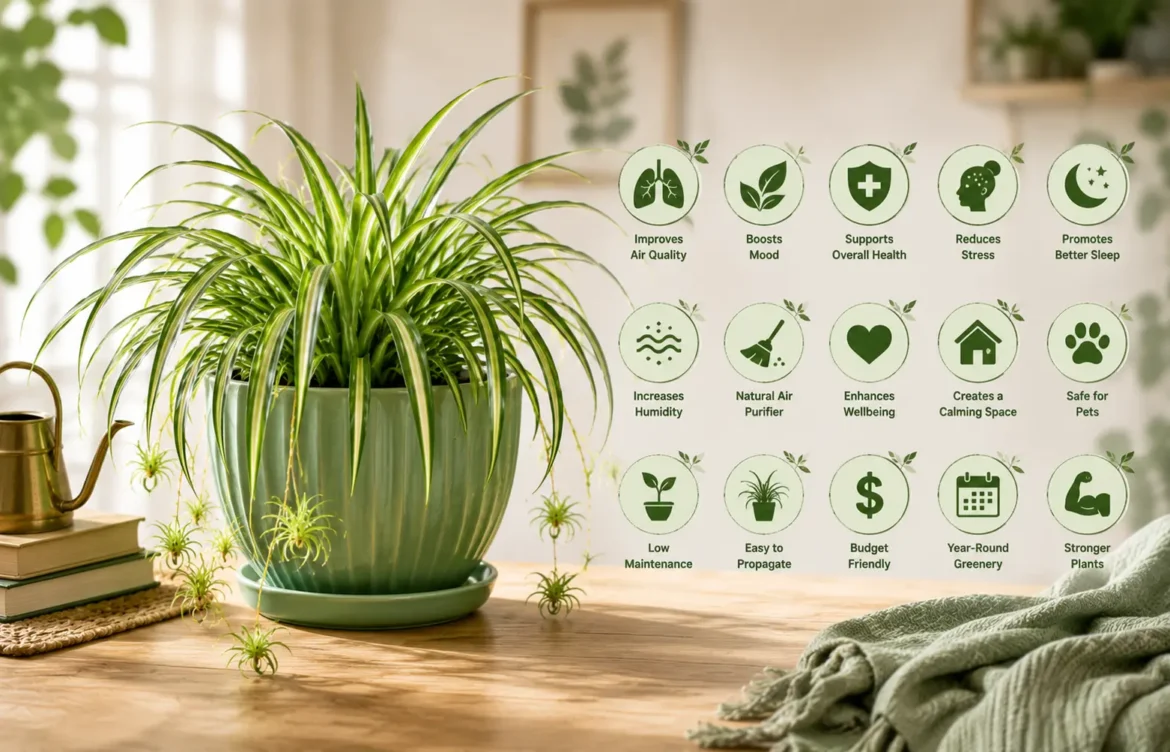
This is the clearest point of difference between Spider Plant and most of the other plants commonly grouped alongside it. Snake Plant is mildly toxic, and both Pothos and Peace Lily are toxic if eaten, while Spider Plant is listed as non-toxic to cats and dogs by the ASPCA. For anyone specifically shopping for a pet-friendly houseplant, that alone can be the deciding factor, and it removes the need to worry about placement out of a curious pet’s reach the way you would with most other popular low light plants.
It Produces Free New Plants on Its Own
A mature Spider Plant naturally sends out long stems tipped with small plantlets, often called babies or pups, which are genetic copies of the parent plant. Unlike Pothos, which needs you to actively take a cutting to propagate it, a Spider Plant does much of the initial work itself simply by growing and maturing. Those plantlets can be rooted into entirely new plants at essentially no cost, which makes a single Spider Plant a genuinely renewable source of new greenery for your own home or to give away.
It Adds Movement and Fullness to a Space
The long, arching leaves and trailing plantlet stems give a Spider Plant a softer, more dynamic look than an upright plant like Snake Plant. Hung or placed on a high shelf, the cascading stems fill vertical space in a way that few other easy, low light plants do as naturally. See the Hanging Indoor Plants guide for setup tips if you’re considering this display style.
It Contributes Modestly to Indoor Air Quality
Spider Plant was one of the species tested in the well-known NASA study from the 1980s that looked at whether common houseplants could absorb airborne chemicals like formaldehyde, and it performed reasonably well among the plants tested. As with every plant that gets cited from that research, the result is worth keeping in proportion: the study used sealed chambers, not a real room with normal airflow, so a single plant won’t meaningfully purify the air in an actual home on its own. It’s a legitimate, modest benefit rather than a replacement for good ventilation.
It Gives Clear, Low-Stakes Feedback
A Spider Plant’s most common issue, brown leaf tips, is visually obvious but rarely serious, and it doesn’t threaten the overall health of the plant the way root rot or severe pest damage might. This makes it a good plant for learning to read plant stress signals without much real risk: a beginner can notice a problem, adjust their care, and see the difference in new growth over the following weeks, all without the plant’s survival being on the line.
It Tolerates a Range of Light Levels
Spider Plant grows best in bright, indirect light but tolerates lower light reasonably well too, just with slower growth. This flexibility makes it a workable choice for a variety of spots around a home, from a bright kitchen window to a moderately lit living room shelf.
It’s Inexpensive and Easy to Find
Because it propagates itself so readily, Spider Plant is one of the most consistently affordable and widely available common houseplants, sold at general garden centers and home improvement stores alike. It’s an easy plant to start with on a small budget, and an easy one to replace or multiply without much expense.
It’s a Recognizable, Familiar Plant for Many People
For a lot of plant owners, Spider Plant carries a bit of nostalgia, since it’s been a common household plant for decades and many people have a memory of one growing in a family home. Beyond the sentimental value, that long track record also means there’s a large amount of accumulated, practical knowledge about growing it successfully, since it’s been a widely kept houseplant for far longer than many newer trending varieties.
FAQs
Is Spider Plant a better choice than Pothos specifically for a home with pets?
For pet safety specifically, yes, Spider Plant is non-toxic while Pothos is toxic if eaten. If pet safety is the main priority and you’re choosing between the two, Spider Plant is the safer option, though Pothos still offers faster growth and more display versatility if toxicity isn’t a concern in your household.
Does a Spider Plant’s air-purifying reputation hold up better than other houseplants tested in the same study?
It performed comparably to several other commonly cited plants from that research, including Pothos and Snake Plant, rather than standing out as dramatically more effective. Its real-world air quality contribution in a normal home is modest across the board, similar to the other plants from that same study.
Is it worth keeping a Spider Plant specifically to propagate and give away as gifts?
Yes, this is one of its more practical, underrated benefits. Because plantlets form on their own once the plant matures, you don’t need to take deliberate cuttings the way you would with many other plants, which makes it an easy, low-effort way to build up a supply of small plants to give away over time.
Are the benefits of a Spider Plant different for someone growing it in an office versus a home?
The core benefits, like pet safety, light tolerance, and easy propagation, apply the same way in either setting. An office may get slightly more specific value from the plant’s tolerance of inconsistent watering and lower light, since offices are less likely to have someone checking on plants daily compared to a home.
Does the plant’s non-toxic status mean it’s completely risk-free for pets to chew on?
Being non-toxic means it won’t poison a pet, but some cats in particular are strongly drawn to chewing Spider Plant leaves, which can still lead to mild stomach upset from eating too much plant material, or simply damage to the plant itself from repeated nibbling.